
Water, Water, Everywhere and Never Enough
Posted by Angela Owen | Sleep Diva on 19th May 2026
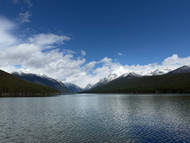
I've spent this past week in the beautiful state of Montana and just visited Glacier National Park. Seeing the glaciers from the edge of Bowman Lake literally left me in total awe. The summer travel season had not yet started, so we had the park almost to ourselves. Standing there at the edge of the lake, the clear blue water, towering snowcapped mountains, reminded me how much water is on the planet, but how little we can actually use. Our little blue planet has 332.5 million cubic miles of water, but only 2.5% is fresh water and only 1.2% of the fresh water is available on the surface and not frozen in glaciers or buried in the groundwater — making less than 1% of all the water available for drinking, manufacturing, maintaining crops, and so on. How we manage our precious water resource is tantamount to our survival.
The mattress industry relies heavily on several inputs: textiles, foams, steel, and wood. Manufacturers have choices on which to use and in myriad combinations. Exploring the sustainability question as it relates to water is more nuanced than one might expect — and gives more complicated answers. Focusing on just these broad inputs, here’s how it all stacks up.
Textiles
More than a dozen years ago, I started looking at Tencel™ as a fiber for pillows — both in the fill and in the cover. My compadres in the organic industry were resoundingly against it and saw it as traitorous to the organic movement. It was my opinion at the time that we needed to also consider water consumption when weighing sustainability options in our products. Lenzing® advertised that Lyocell (Tencel™) uses 20 times less water to produce than cotton — staggering, especially considering it comes from trees.
The textile industry uses 1.5 trillion liters of water annually, with cotton being the most water-intensive fiber of them all. Producing just one kilogram of cotton — roughly enough fabric for a queen-size pillowcase — requires an average of 10,000 liters of water from cultivation through processing. Even after the growing and harvesting stages, cotton fiber still requires roughly 15–20 gallons of water per pound just for the dyeing, printing, and finishing processes alone. It’s worth noting that the suppliers most mattress manufacturers rely on for ticking don’t serve only the bedding industry — they also supply apparel and automotive textiles. The cotton water problem runs through the entire supply chain, and when you buy a cotton-heavy ticking, you’re downstream of all of it.
Polyester isn’t a water-wise alternative either — though the argument against it is less about consumption and more about contamination. Like polyurethane foam, polyester begins its life in a crude oil refinery, where naphtha is cracked at extreme temperatures to produce the chemical precursors that are eventually polymerized into PET fiber. In 2022 alone, 70 million barrels of oil were required to produce the world’s polyester supply. The direct water used in manufacturing is relatively modest compared to cotton — but what happens to that water tells a different story. The dyeing and finishing of polyester fabrics relies on synthetic dyes, many of them azo-based or containing heavy metals, that are toxic to aquatic life and potentially deadly to humans if not properly treated — and in many textile-producing regions, they aren’t. Then there’s the ongoing problem that doesn’t end at the factory gate: synthetic textile laundering has been identified as responsible for up to 90% of primary microplastics in the oceans, with polyester the primary culprit. A mattress ticking isn’t laundered like a shirt, but it does eventually end up in a landfill — where it continues shedding microplastic particles into soil and groundwater for decades. Trading water consumption for water contamination is not a trade worth making.
Foams: Polyurethane vs. Latex
Polyurethane foam is the workhorse of the conventional mattress industry — cheap, lightweight, and endlessly shapeable. But from a water perspective, it carries a hidden burden. Water is used extensively in polyurethane production, especially during the cooling and cleaning processes, as well as indirectly to generate the electricity consumed during manufacturing — contributing to the depletion of freshwater resources, with the discharge of wastewater posing additional pollution risks.
Natural latex tells a different story — though not a simple one. Natural latex comes from the sap of the Hevea brasiliensis rubber tree, tapped in a process similar to maple syrup production; the sap is then whipped and baked into solid foam. The rubber tree’s relationship to water is fundamentally agricultural rather than industrial — rubber plantations transpire 4–6 mm of water vapor daily, drawing largely on rainfall rather than managed freshwater inputs. That dependency on rainfall, rather than diverted freshwater, is a meaningful distinction. Trees actively absorb carbon dioxide during their growth, acting as natural carbon sinks, and are typically replanted after 25–30 years, at which point they yield a valuable secondary product as medium-density tropical hardwood.
Natural latex demonstrates advantages in biodegradability and renewable resource utilization, typically achieving superior scores in carbon footprint assessments — though transportation emissions from tropical production regions and land use considerations present ongoing challenges. No material is without trade-offs. But the contrast between a petroleum-derived foam that requires industrial water inputs and a tree-tapped product that runs largely on rain is a meaningful one.
Steel
Steel in a mattress is almost invisible to the consumer — buried inside the coil system, never seen, rarely thought about. But its water and environmental footprint starts long before the spring is wound. Iron mining requires large quantities of fresh water, placing significant stress on local water supplies. The subsequent smelting and processing of iron into steel demands enormous energy inputs and generates substantial emissions — approximately 1.9 to 2.5 kg of CO² equivalent per kilogram of material.
The good news about steel is its recyclability. Adopting recycled steel in coil manufacturing can reduce carbon emissions by 40–60% compared to virgin steel production. The bad news is that most mattresses don’t make it to recycling at all — most are composed of 85–90% recyclable materials, yet recycling remains uncommonly practiced, with steel springs ending up in landfills where they can leach harmful substances into soil and water over time. Steel has the infrastructure for a truly circular story; the industry just hasn’t built the path to get there.
Wood
Wood feels like the easy win in this conversation — it’s natural, it grows back, it sequesters carbon. And largely, that’s true. The water footprint of a sustainably managed forest is essentially the rain that falls on it. Unlike cotton farming, which requires intensive irrigation, or iron mining, which draws on freshwater reserves, timber production in a well-managed forest is a net beneficiary of the water cycle, not a drain on it.
The critical qualifier is how the wood is sourced. FSC certification ensures that trees are harvested and managed responsibly to prevent deforestation, that forest areas with irreplaceable value are identified and maintained, and that plant and animal species are protected. An FSC label means the wood came from a responsibly managed forest where trees are replanted, biodiversity is protected, and workers are treated fairly. When it comes to wood, the certification isn’t just a feel-good label — it’s the difference between a material that supports a watershed and one that quietly degrades it.
How It All Stacks Up
The table below distills the key water and sustainability considerations for each major mattress input at a glance.
| Material | Water consumption | Water impact type | Other concerns | Better alternative |
|---|---|---|---|---|
| Conventional cotton
Ticking & fill
|
Very high
~10,000 L per kg of fabric
|
Irrigation of water-stressed farmland; dyeing & finishing effluent | Grown in water-scarce regions; heavy pesticide use contaminates groundwater | GOTS organic cotton; Tencel™/Lyocell (uses 20× less water) |
| Wool
Ticking, fill & fire barrier
|
Variable
500–17,000 L per kg depending on region & method
|
Mostly green water (rainfall on pasture) rather than diverted irrigation — a meaningful distinction | High methane emissions from sheep; scouring & dyeing effluent; demand partly driven by fire retardancy regulations | Certified responsible wool (RWS); recycled wool; pasture-raised from low water-stress regions |
| Polyester
Ticking & fill
|
Low (direct)
~17 L per kg — but contaminates what it uses
|
Toxic dyeing effluent; microplastic shedding into waterways for the life of the product | Crude oil-derived; not biodegradable; sheds ~1,900 microfibers per wash; 70M barrels of oil used globally in 2022 | Recycled polyester (rPET); or eliminate in favor of natural fibers |
| Tencel™ (Lyocell)
Ticking & fill
|
Very low
~20× less than conventional cotton
|
Closed-loop solvent process; minimal effluent; solvent recaptured and reused | Tree-derived (beech/eucalyptus); biodegradable; once controversial in organic circles but increasingly accepted | Already the better option — look for OEKO-TEX certification |
| Polyurethane foam
Comfort & support layers
|
Moderate (indirect)
Industrial cooling & cleaning; upstream petrochemical process
|
Crude oil refining is energy & water intensive upstream; wastewater from manufacturing | Petroleum-derived; off-gasses VOCs; not biodegradable; ends up in landfill | Natural latex (rain-fed; biodegradable; GOLS-certified) |
| Natural latex
Comfort & support layers
|
Low
Rain-fed; transpires 4–6 mm/day from rainfall
|
Agricultural, not industrial; draws on rainfall rather than diverted freshwater | Shipping emissions from tropical regions; latex allergy affects ~1–6% of population | GOLS-certified organic latex; Dunlop process is more water-efficient than Talalay |
| Steel (innerspring)
Support core
|
High (upstream)
Iron mining stresses local freshwater supplies
|
Mining draws heavily on local water; steel production requires extreme heat & cooling water | 1.9–2.5 kg CO² per kg of steel; difficult end-of-life separation; leaches in landfills | Recycled steel (cuts carbon 40–60%); proper mattress recycling programs |
| Wood
Foundation & frame
|
Very low
Rain-fed; managed forests support the water cycle
|
Net positive when responsibly sourced — forests regulate watersheds | Solvent-based finishes introduce VOCs & chemical runoff; irresponsible logging degrades watersheds | FSC-certified timber; water-based, low-VOC finishes |
Water consumption figures are approximate industry averages. “Direct” water refers to manufacturing inputs; “indirect” or “upstream” water includes supply chain processes. The wool range reflects significant variation by geography and farming method.
The mattress industry, like most manufacturing sectors, presents no clean heroes — only better and worse choices, and choices that require you to look past the surface. Cotton’s thirst is well-documented; latex runs on rain; polyurethane’s water story begins at the oil well; steel mines the watershed; wood either protects or plunders depending entirely on how it’s sourced. The good news is that for each input, a more sustainable path exists. The harder truth is that consumers can’t easily see these choices when they’re lying on a showroom floor. That’s why transparency — in certifications, in sourcing, in honest conversation about trade-offs — matters as much as the materials themselves.