
Earth Day and the Sustainability Blind Spots the Mattress Industry Doesn’t Want to Talk About
Posted by Angela Owen | The Sleep Diva on 20th Apr 2026
Every April 22nd, industries across the country take stock of their environmental footprint. Press releases go out. Certifications get highlighted. Social feeds turn green. The mattress industry is no exception — and in fairness, real progress has been made. Certifications like GOLS, GOTS and the new Moreganic Certification, reduced chemical usage, and responsibly sourced materials are all meaningful steps forward.
But this Earth Day, we want to have a more honest conversation. Because the sustainability dialogue in our industry has a serious blind spot: it almost exclusively focuses on what goes into a mattress, not what happens when a mattress reaches the end of its life. And it rarely asks the harder question — why are mattresses reaching the end of their life so soon in the first place?
What Happens After the Sale?
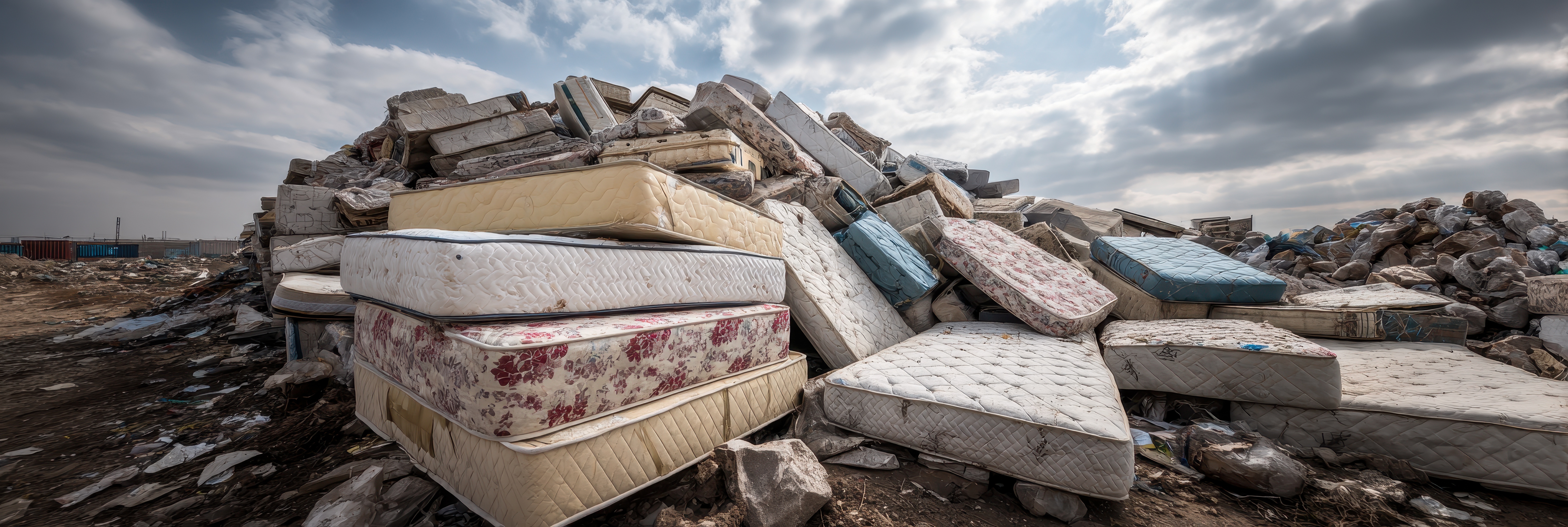
More than 50,000 mattresses are discarded in the United States every single day. Let that sink in for a moment. It means that over the course of this Earth Day alone, tens of thousands of mattresses will be hauled away, and the vast majority, somewhere between 75 and 80%, will end up in a landfill. Mattresses can’t be compacted, so a single king-size takes up approximately 40 cubic feet of landfill space, and at current rates, discarded mattresses occupy an estimated 750–800 million cubic feet of landfill capacity annually.
Recycling is rarely part of the conversation at the point of sale, and the numbers show it. According to the Mattress Recycling Council — the nonprofit that administers the country’s statewide mattress recycling programs — about 75% of the materials in the average innerspring mattress can be recovered and resold to secondary markets, yet fewer than 10% of mattresses discarded in the US are currently recycled. The technology and infrastructure to do far better already exists. What’s missing is urgency.
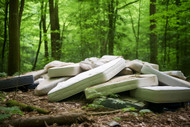
The end-of-life problem compounds dramatically when disaster strikes. Wildfires, hurricanes, and floods don’t just destroy mattresses — they can turn them into environmental hazards, releasing synthetic foams, flame retardants, and chemical compounds into soil and waterways with no pathway to recovery or remediation. This is a dimension of mattress sustainability that no certification currently addresses, and one that becomes harder to ignore as extreme weather events grow more frequent. Even worse, it goes unregulated and unchecked as the toxins contaminate soil and waterways for decades to come.
The Longevity Problem Nobody Is Talking About
The second blind spot is perhaps more uncomfortable because it implicates the business model itself: longevity is almost never part of the sustainability conversation.
I recently helped my son move into a new apartment and realized he had the same hand-me-down mattress that my daughter had when she lived at home over a dozen years ago. Since it was from our kid’s collection, I wasn’t surprised that it was still in perfect condition and has a good decade more to go.
The industry has converged around an 8-year replacement cycle, and much of the marketing — from extended sleep trial programs to annual product refreshes — subtly reinforces the idea that mattresses are semi-disposable. Building a mattress to last 15 or 20 years is technically achievable. It’s just not particularly good for driving repeat purchases. True sustainability requires asking how long a product can responsibly serve its purpose before it needs to be replaced. A mattress that lasts twice as long doesn’t just save the consumer money — it cuts the environmental footprint of manufacturing, transportation, and disposal in half. That calculation never appears on a hang tag or in a sustainability report.
A Different Kind of Conversation
Earth Day is a useful reminder that environmental accountability doesn’t stop at the factory door. Sustainability that only counts inputs is incomplete. An honest accounting must follow a mattress all the way through its life — how long it lasts, what it becomes when a natural disaster renders it toxic waste, and whether the more than 90% of mattresses that still bypass recycling represents a failure of infrastructure, of intention, or of both.
Each month in this space, we’ll return to these themes — not to shame an industry we’re part of, but to push it, and ourselves, toward a higher standard. Because if Earth Day means anything, it means being willing to ask the questions that are inconvenient to answer.
Visit the Specialty Sleep Association's Blog for more on sustainability in the mattress industry each month.