
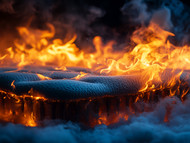
Playing With Fire, Part 1: How We Ended Up With Chemicals in Our Beds
Posted by Angela Owen, Sleep Diva on 24th Aug 2026
I sold my first mattress in 2000, out of a little retail store in Boulder, Colorado called Boulder By Design. Back then, there was exactly one flammability hurdle a mattress had to clear: the cigarette test. Lab techs would set 18 lit cigarettes on a mattress surface — nine on the bare surface, nine tucked under two sheets — and if the char never spread more than two inches, it passed. Our cotton and wool sailed through. Natural fibers do that.
In 2007, the rules changed. The new federal standard, 16 CFR 1633, replaced the cigarette with a torch: propane burners aimed at the top, bottom, and side of a mattress for an extended exposure, and if it ignited, the flame had to self-extinguish within a set time. We still passed without chemicals — a quilted wool layer and a wool flange behind our tight fitting, zippered cover did the job on our builds. But a lot of the industry reached for a cheaper fix: chemical flame retardants, and in some cases fiberglass combined with halogenated chemicals or chlorinated compounds and antimony baked into the foam. We are a small, boutique manufacturer, and cater to a higher-end, organic consumer. Affordability made it hard for the majority of the industry to adapt to these laws without using a chemical solution.
Then in 2013, we took on a hospitality project in the UK, which meant clearing Crib 5 — the British Standard BS 5852, a component-level test where each individual material in the mattress is set on fire and has to self-extinguish on its own. It's a materially harder standard than anything in the US. We passed by adding graphite to our latex, which was a genuinely new idea in the industry at the time. Chemicals, again, weren't required.
I want to use this three-part series to ask the question I've been sitting with for two decades: why does this country — and only one other country in the world — require this? Who is it actually protecting, and at what price? This first installment covers how we got here. The second will look at whether any of it actually works, and what it's cost us to find out.
The US and the UK Stand Alone
Here's the thing that should stop you: no other country regulates mattress and furniture flammability the way the United States and the United Kingdom do. The EU's baseline standard, EN 1021, tests only for cigarette and match ignition — roughly a twentieth of the heat output of the UK's Crib 5 wood-crib test. Furniture that would sail through most of Europe wouldn't come close to clearing what we require here.
That's not a small footnote. It means the entire chemical flame-retardant industry, as it exists in mattresses and furniture, is essentially propped up by two countries' regulations. Everywhere else, manufacturers make furniture that ignites more easily and nobody considers it a crisis.
Where the Rules Actually Came From
This is the part of the story the industry would rather you not think too hard about.
In the 1970s, smoldering cigarettes were sparking house fires and killing people. The tobacco industry had an obvious, if unpopular, fix available: make a cigarette that would self-extinguish if left unattended. Instead, it fought that fix for decades — and, according to a Pulitzer Prize–winning 2012 investigation by the Chicago Tribune, worked to redirect the blame onto the furniture those cigarettes were landing on. If furniture itself could be made flame-resistant, cigarettes would no longer need to change.
 That campaign eventually handed the baton to the chemical manufacturers. In 2007, the same year 16 CFR 1633 took effect, the three largest flame-retardant producers in the world — Albemarle, Chemtura, and ICL Industrial Products, together controlling more than 40% of the global market — founded a group called Citizens for Fire Safety. It presented itself as a coalition of fire professionals and doctors. It was, in fact, funded entirely by those three companies, to the tune of roughly $17 million between 2008 and 2010, and its job was to lobby state legislatures to keep flame-retardant mandates in place.
The Tribune's reporting found that one of the group's star witnesses, a prominent burn surgeon, testified repeatedly before state legislatures about infants who had died in fires because their bedding lacked flame retardants. Specific babies, specific dates, specific injuries. None of those children existed. When confronted, the doctor said the testimony wasn't "under oath," so it didn't need to be true.
Meanwhile, the CPSC's own staff scientist who oversaw federal flammability testing in 2009 told the Tribune plainly: flame retardants in foam provided no significant fire protection. Most fire deaths come from smoke inhalation, not flame contact — and the tests being used to justify pounds of chemicals per mattress weren't measuring that.
The reporting led to Senate hearings, an EPA review, and California's eventual overhaul of its own furniture flammability rule. It did not lead to a rethinking of 16 CFR 1633 itself.
Next time: does any of this actually work — and what has it cost the people sleeping on it, the firefighters who respond when it burns, and the environment it ends up in?